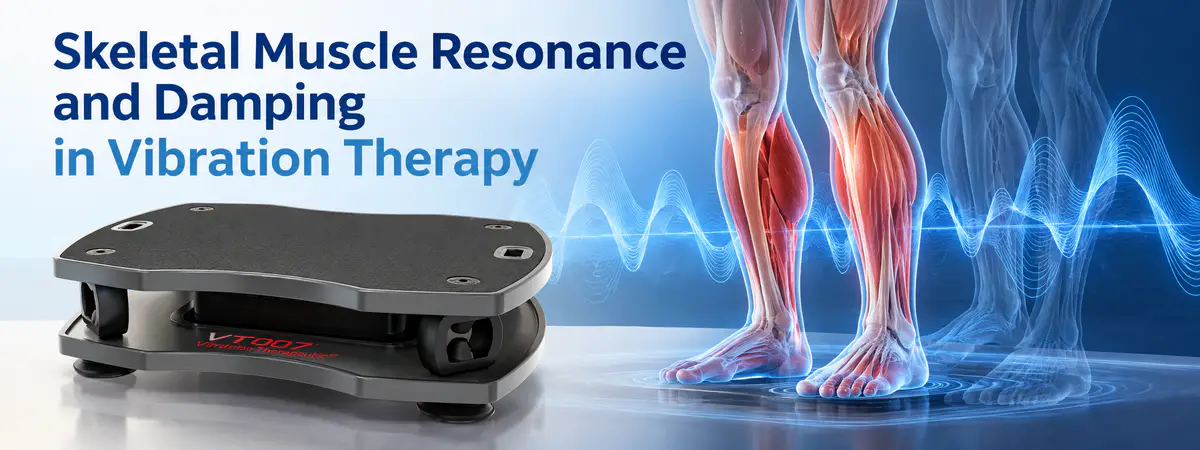
Skeletal Muscle Resonance & Damping in Response to Vibration
Vibration therapy uses mechanical vibration to stimulate skeletal muscles and induce involuntary muscle contractions. The response of skeletal muscles to vibration is influenced by vibration frequency, muscle resonance and active damping. Understanding these interactions helps explain how vibration frequency affects muscle activation and the effectiveness of vibration therapy.
Skeletal muscles are particularly interesting because their mechanical properties change with muscle activation. When a muscle contracts, its stiffness generally increases, altering its resonance characteristics and response to vibration. At the same time, active muscle contraction can increase vibration damping, reducing the amplitude of tissue oscillation.
Content Index
- Resonance Frequency of Human Body and Tissues
- Skeletal Muscle Damping Effect on Vibration
- How Different Vibration Frequencies Affect the Body and Skeletal Muscles
- Summary & Reference
Resonance Frequency of Human Body and Tissues
When an object is subjected to external vibration, its response depends on the applied vibration frequency and its mechanical properties. When the applied frequency approaches one of the object's natural frequencies, its vibration amplitude may increase significantly. This phenomenon is called resonance, and the corresponding frequency is called the resonance frequency.
An object's natural frequency is primarily determined by its mass and stiffness. Generally, an object with greater stiffness has a higher natural frequency, while an object with greater mass has a lower natural frequency, assuming other mechanical properties remain unchanged.
The human body is a complex mechanical system composed of bones, muscles and other soft tissues. Different body segments and tissues have different resonance characteristics. Their responses to vibration also depend on body posture, muscle activation and vibration direction.
| Body or Tissue | Approx. Resonance Frequency |
| Human Body as a whole | 5-10Hz |
| Lower-limb Soft Tisues | 10-50Hz |
| Major Skeletal Muscle Group Relaxed | 10-15Hz |
| Major Skeletal Muscle Group Activated | 25-40Hz |
Major skeletal muscle groups exhibit different resonance characteristics depending on their activation state. When activated, their stiffness generally increases, changing their mechanical response to vibration. Based on the literature reviewed and our practical observations, we identify approximately 25–40 Hz as a relevant frequency range for the vibration response of activated major skeletal muscle groups.
Resonance Frequency of Human Body As a Whole
The human body as a whole exhibits relatively low resonance frequencies due to its large mass and flexible structure. Under certain conditions, its principal resonance frequency during vertical vibration falls approximately within the range of 5–10 Hz.
The body's rigidity is also influenced by posture and vibration direction. Tensing your body in a particular direction generally increases its natural frequency in that direction, while relaxing decreases it. Therefore, to a certain extent, you can control your body's resonance frequency.
Resonance Frequency of Soft Tissues
Compared with the body as a whole, individual soft tissues generally have smaller masses and different mechanical properties. Consequently, their resonance frequencies can be higher, exhibiting an approximate range of 10–50 Hz.
Resonance Frequency of Skeletal Muscle
Unlike many other soft tissues, skeletal muscles can actively change their mechanical properties, including stiffness and damping. Consequently, their resonance characteristics depend on their state of activation.
When a skeletal muscle is relaxed, it has relatively low stiffness and a correspondingly low natural frequency. When the muscle contracts, its stiffness increases, raising its natural frequency.
In relax state, a major skeletal muscle group's resonance frequency is around 10-15Hz. In contraction state, the resonance frequency of the same muscle group can achieve around 25-40Hz.
Due to skeltal muscle's natural stretch reflex response, skeletal muscles respond to vibration stimulation with contraction and therefore increase their resonance frequency.
Naturally, skeletal muscles tend to hold their muscle length. If stretched, skeletal muscles spontaneously contract. This is called skeletal muscle’s stretch reflex response.
Skeletal Muscle Damping Effect on Vibration
When vibration is transmitted to skeletal muscles, repeated stretching can trigger involuntary muscle activation through the stretch reflex. This activation increases muscle stiffness, raising its natural frequency, while active damping reduces the amplitude of tissue oscillation.
Through this response, skeletal muscles can resist externally applied vibration rather than simply oscillating with it. Research has demonstrated that muscle activity can increase soft-tissue damping, particularly when the applied vibration approaches the tissues' natural frequencies.
How Different Vibration Frequencies Affect the Body and Skeletal Muscles
Different vibration frequencies produce different mechanical responses in the human body. Lower frequencies tend to produce greater whole-body movement, while higher frequencies can stimulate the resonance and damping responses of individual tissues, particularly skeletal muscles.
Whole Body Response
Whole body as an object has the resonance frequency range between 5Hz and 10Hz. A pivotal oscillation plate (usually run below 15Hz) can achieve resonance on the whole body. In other words, pivotal oscillation plate can swing the body more vigorously. At this lower frequency range does not engage much muscle contraction. Therefore, although muscles swing visibly, but they are loose.
Skeletal Muscle Response
Soft tissues’ resonance frequency ranges between 10Hz and 50Hz. A linear vibration plate (usually run between 15Hz and 40Hz) can achieve resonance on soft tissues.
However, for skeletal muscles, the damping effect tends to keep the muscle out of resonance. A linear vibration plate can effectively induce muscle contraction. The muscles appear tense, not swinging much on vibration.
Pivotal Oscillation Plate vs Linear Vibration Plate
Understanding how different vibration frequency influence your body and tissues can help you choose the right vibration plate for your intended purpose.
If you want a vibration plate to shake your whole body vigorously without intensive muscle contraction, you can choose a pivotal oscillation plate which usually run below 15Hz.
If you want a vibration plate to induce rapidly repeated intensive muscle contraction, you can choose a linear vibration plate which usually run from 15Hz to 40Hz.
Summary
The human body and skeletal muscles respond differently to vibration depending on its frequency and their mechanical properties. Resonance can amplify vibration, while skeletal muscle activation increases stiffness and damping, reducing tissue oscillation.
Low-frequency pivotal oscillation plates typically produce greater visible body movement. Higher-frequency linear vibration plates can induce rapidly repeated muscle activation, increasing muscle tension while reducing visible oscillation. Greater visible movement does not necessarily indicate greater muscle activation.