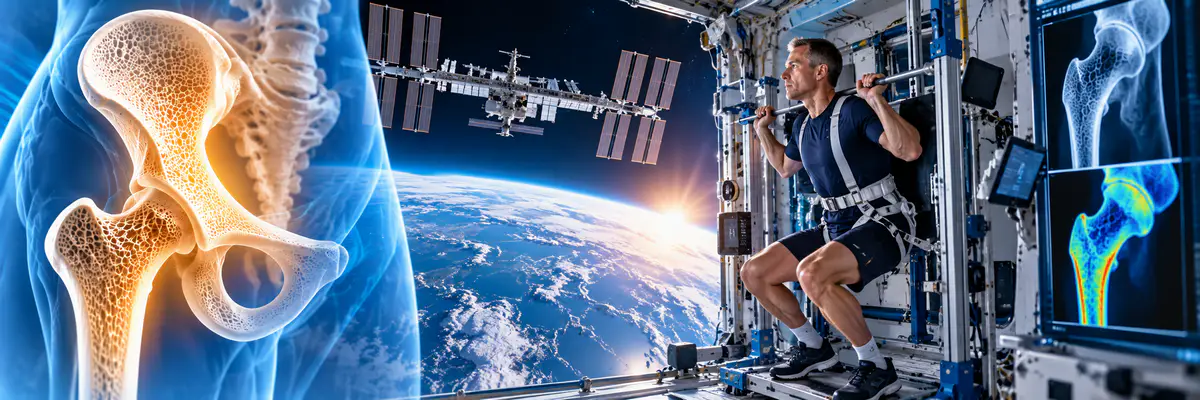
Bone Loss in Space — What NASA Research Tells Us
Space travel provides a unique opportunity for studying bone loss and exploring ways to prevent it.
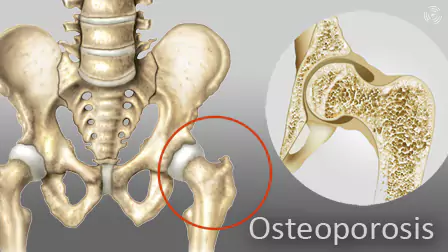
According to NASA, astronauts living in microgravity environment can lose approximately 1% to 1.5% of bone mineral density per month in weight-bearing bones.
NASA's research demonstrates the importance of mechanical loading and the need for sufficient loading magnitude to prevent bone loss. These findings have guided the development of specialized exercise equipment for the International Space Station, establishing mechanical loading as a central strategy for preserving bone density.
Mechanical Loading Is Essential
On Earth, our bones experience mechanical loading throughout the day. Gravity produces weight-bearing forces, while skeletal muscle contractions generate additional forces transmitted to bones through tendons and joints.
In space, much of this mechanical loading disappears. According to NASA, earlier spaceflight studies found that, without effective countermeasures, astronauts could lose approximately 1% to 1.5% of bone mineral density per month in weight-bearing bones, with considerable variation among individuals and skeletal regions.
Bone remodeling continues in space, but the balance between bone formation and resorption is disrupted. When bone resorption exceeds bone formation, bone mass progressively declines. The effects are particularly pronounced in weight-bearing regions, such as the hips and lower extremities, which normally experience substantial mechanical loading on Earth.
NASA therefore uses exercise as a major countermeasure against bone and muscle loss during long-duration spaceflight. Resistance exercise is particularly important because it can generate substantial musculoskeletal forces even when body weight is largely absent.
Loading Magnitude Matters
Early astronauts on the International Space Station exercised regularly, but bone loss remained a problem. One important limitation was that the exercise equipment could not provide sufficient loading magnitude.
NASA measurements found that forces generated during treadmill exercise in space were substantially lower than those generated during running on Earth. The early Interim Resistive Exercise Device (iRED) also had limited loading capability.
iRED provided a maximum resistance of approximately 297 pounds. Research found that it provided little additional protection against bone loss compared with the exercise systems used during earlier space programs.
NASA subsequently developed the Advanced Resistive Exercise Device (ARED), which was installed on the International Space Station in 2008. ARED can provide resistance of up to approximately 600 pounds — almost twice the maximum resistance available from iRED.
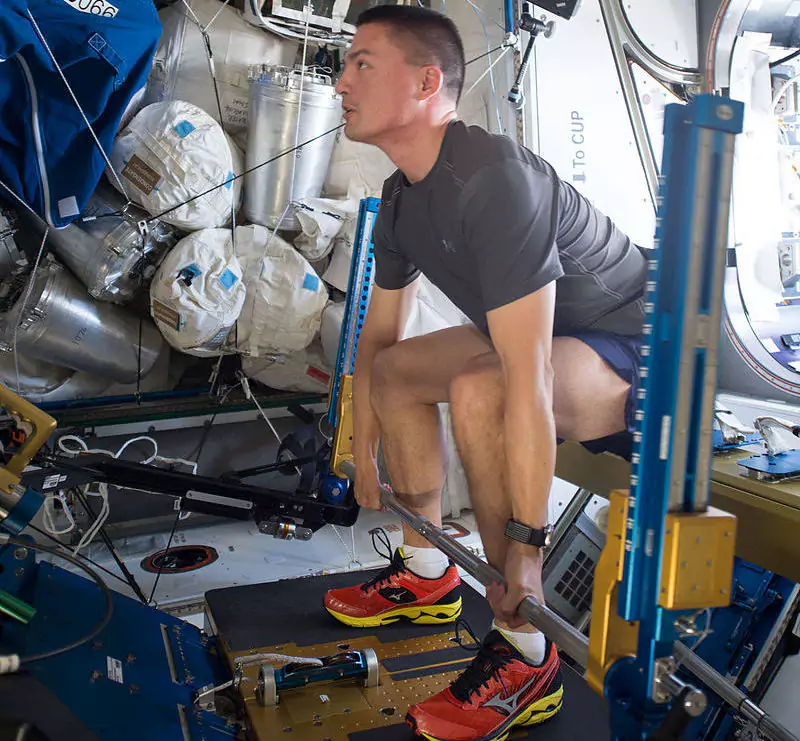 ARED Exercise in Space Station
ARED also provides a more consistent load through the exercise range and allows astronauts to perform heavy lower-body exercises such as squats, deadlifts and heel raises.
The results were substantially better.
A NASA study comparing astronauts using the two systems found that crew members exercising with ARED maintained bone mineral density in most measured skeletal regions during four- to six-month missions. Astronauts using the earlier iRED had experienced substantially greater bone loss.
Bone metabolism measurements also showed increased bone formation in the ARED group. Bone resorption still increased during spaceflight, so ARED did not stop the underlying increase in bone breakdown. Instead, increased bone formation helped offset it.
Nutrition also contributed to the improved results. The ARED astronauts maintained adequate energy intake and vitamin D status. The study therefore does not prove that resistance magnitude alone produced the improvement.
However, the overall NASA experience supports a clear principle: the amount of mechanical loading matters. NASA's later assessments identify resistance and treadmill volume loads as important countermeasure factors associated with better bone outcomes.
During resistance exercise, skeletal muscles contract against the applied resistance. These muscle forces are transmitted through tendons and joints to the connected bones. Greater resistance requires greater muscle force and can therefore increase the mechanical loading experienced by the skeleton.
NASA Also Investigated Vibration
NASA also funded research into vibration as a possible alternative mechanical countermeasure. This research should be distinguished from ARED, which became operational exercise equipment on the International Space Station.
The vibration research was led by Clinton Rubin, Ph.D., and colleagues at Stony Brook University. The project was called VIBE — Vibrational Inhibition of Bone Erosion.
Rubin's hypothesis was different from conventional resistance exercise. He proposed that extremely small mechanical signals repeated at high frequency could influence bone even though their magnitude was very low.
The NASA-funded bed-rest experiment tested vibration at 30 Hz and approximately 0.3 g for 10 minutes per day. Subjects remained in six-degree head-down bed rest for 90 days to simulate prolonged musculoskeletal unloading. A harness and spring system maintained loading against the vibration platform.
The results were mixed but scientifically interesting. Some ultrasound measurements of the heel favored the vibration group. Bone mineral density measurements also showed numerically less bone loss in some regions, but the BMD differences did not reach statistical significance.
NASA considered VIBE as a possible International Space Station experiment. NASA planning documents from 2008 state that the flight experiment was placed on hold pending the results of the ground-based study.
VIBE was not adopted as the primary bone-loss countermeasure used by astronauts on the International Space Station. NASA's operational approach instead developed around substantial resistive exercise with ARED, together with treadmill and cycle exercise and appropriate nutrition.
The VIBE research therefore demonstrates that NASA investigated low-magnitude vibration as a possible mechanical countermeasure. It should not be interpreted as evidence that NASA established 0.3 g vibration as an effective treatment for osteoporosis.
What NASA Research Tells Us
NASA's experience provides an unusually clear sequence of evidence.
- Without mechanical loading, weight-bearing bones rapidly lose density.
- Early ISS exercise reduced some physical deterioration but did not adequately prevent bone loss.
- With ARED, astronauts achieved much better preservation of bone mineral density, demonstrating the importance of sufficient mechanical laoding.
- For vibration therapy, very low vibration G-force is not established as an effective treatment for osteoporosis.
References
- Counteracting Bone and Muscle Loss in Microgravity.NASA
- Astronaut Exercise. NASA
- Office of the Chief Health and Medical Officer. Exercise Overview. NASA
- Smith SM, Heer MA, Shackelford LC, Sibonga JD, Ploutz-Snyder L, Zwart SR. Benefits for bone from resistance exercise and nutrition in long-duration spaceflight: evidence from biochemistry and densitometry. Journal of Bone and Mineral Research. 2012;27(9):1896–1906. PubMed
- NASA Study Provides New Findings on Protecting Astronauts' Bones Through Diet and Exercise. NASA
- Muir JW, Xia Y, Holguin N, Judex S, Qin Y, Evans H, Lang T, Rubin C. Low Magnitude Mechanical Signals Reduce Risk-Factors for Fracture during 90-Day Bed Rest. NASA Technical Reports Server
- Qin YX, Xia Y, Muir J, Lin W, Rubin CT. Quantitative ultrasound imaging monitoring progressive disuse osteopenia and mechanical stimulation mitigation in calcaneus region through a 90-day bed rest human study. Journal of Orthopaedic Translation. 2019;18:48–58. PubMed