How Vibration Therapy May Help Treat Osteoporosis
Vibration therapy has increasingly recognized as a potential non-pharmacological treatment for osteoporosis. Although its underlying mechanisms remain incompletely understood, clinical studies have demonstrated improvements in bone mineral density under certain treatment conditions.
In this article, we explore how vibration therapy may influence bone remodeling, focusing on the mechanical loading generated through vibration-induced skeletal muscle contractions. We examine how vibration frequency, G-force, exercise posture, and other treatment parameters influence the characteristics and magnitude of this mechanical loading and its potential effects on bone adaptation.
Content Index
- Mechanical Loading of Bone through Muscle Contraction
- Vibration-Induced Mechanical Loading
- Vibration Equipment & Training Poses
- Summary
- References
Mechanical Loading of Bone through Muscle Contraction
It is scientifically established that mechanical loading generated by skeletal muscle contractions plays a fundamental role in maintaining bone integrity and regulating bone remodeling.
Skeletal muscle contractions transmit mechanical forces to bones through tendons and joints. When these forces produce dynamic mechanical loading of sufficient magnitude and are repeatedly applied over time, they can stimulate cellular responses that regulate bone formation and remodeling.
This well-established principle provides the scientific basis for recommending resistance and weight-bearing exercises to maintain and improve bone health.
Vibration-Induced Mechanical Loading
Vibration therapy produces a distinctive form of dynamic mechanical loading through vibration-induced skeletal muscle contractions. Two key characteristics of the vibration stimulus—frequency and acceleration (G-force)—influence the repetition rate and magnitude of this mechanical loading.
Through the muscle stretch reflex, vibration induces repeated neuromuscular responses and involuntary muscle activation. Simultaneously, vibration acceleration (G-force) generates inertial forces and muscle contraction force on bones, contributing to dynamic mechanical loadings of bone.
The effect is a distinctive pattern of rapidly repeated mechanical loading, with high-magnitude pulses arising from the combined effects of muscle-generated and inertial forces. This pattern of mechanical stimulation cannot readily be reproduced through voluntary muscle contractions during conventional exercise.
| Vibration Attribute | Mechanical Effect |
|---|---|
| Frequency | Rapidly repeated mechanical stimulation that induces neuromuscular responses and involuntary muscle activation. |
| G-force | Dynamic acceleration that generates inertial forces and influences muscle contraction forces, producing high-magnitude pulses of mechanical loading on bones under suitable conditions. |
Vibration-Induced Mechanical Loading Explained with an Example
Consider a person weighing 180 lb performing squats on a linear vibration plate operating at 30 Hz with a nominal G-force of 2G.
At 30 Hz, the vibration plate produces 30 movement cycles per second, repeatedly stretching and stimulating the leg muscles. This rapid stimulation can induce involuntary muscle activation through the stretch reflex, generating muscle contraction forces that are transmitted through tendons to the bones as repeated mechanical loading.
During the upward acceleration phase of each vibration cycle, a nominal G-force of 2G corresponds to an additional acceleration-related force of 180 × 2 = 360 lbf, assuming the entire body follows the platform's acceleration. This rapidly changing force increases the mechanical demands on the leg muscles, potentially inducing stronger muscle contractions. Together, the acceleration-related forces and muscle-generated forces contribute to high-magnitude pulses of mechanical loading transmitted to the bones.
Vibration produces rapidly repeated, short-duration pulses of mechanical loading. At 30 Hz, each vibration cycle lasts approximately 0.033 seconds, with the upward acceleration phase lasting only 0.0083 seconds. During this brief phase, the calculated additional acceleration-related force averages 360 lbf under our simplified assumptions. The actual mechanical loading transmitted to bones depends on the combined effects of acceleration, muscle contraction and body posture.
Vibration can produce rapidly repeated, high-magnitude pulses of mechanical loading at frequencies that cannot readily be achieved through conventional exercise. By engaging the body's natural neuromuscular responses, this distinctive form of mechanical stimulation provides a plausible pathway through which vibration intervention may influence bone remodeling.
Vibration Equipment & Training Poses
Vertical Mechanical Loading & Linear Vibration Plate
From a biomechanical perspective, our musculoskeletal system generates forces to support body weight, maintain posture and balance, and produce movement against gravity. Vertical mechanical loading plays an important role in stimulating bone adaptation, particularly in weight-bearing bones.
Of the two major types of vibration plates, linear vibration plates produce predominantly vertical movement and acceleration (G-force), delivering mechanical stimulation along the body's natural weight-bearing axis.
| Linear Vibration | Pivotal Oscillation |
|---|---|
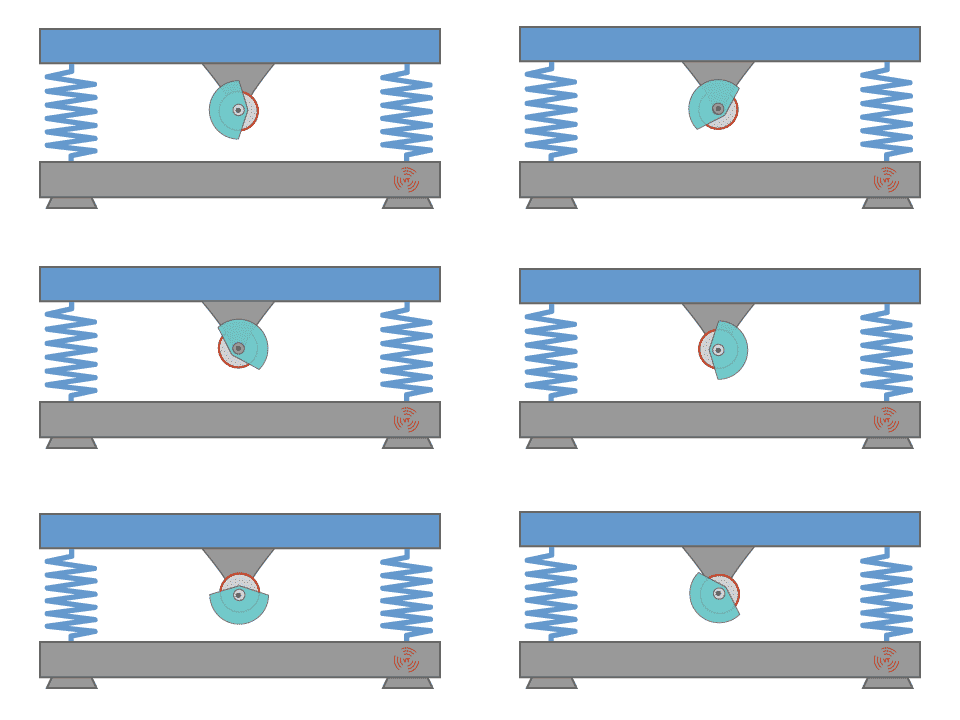 High Frequency
Low Amplitude |
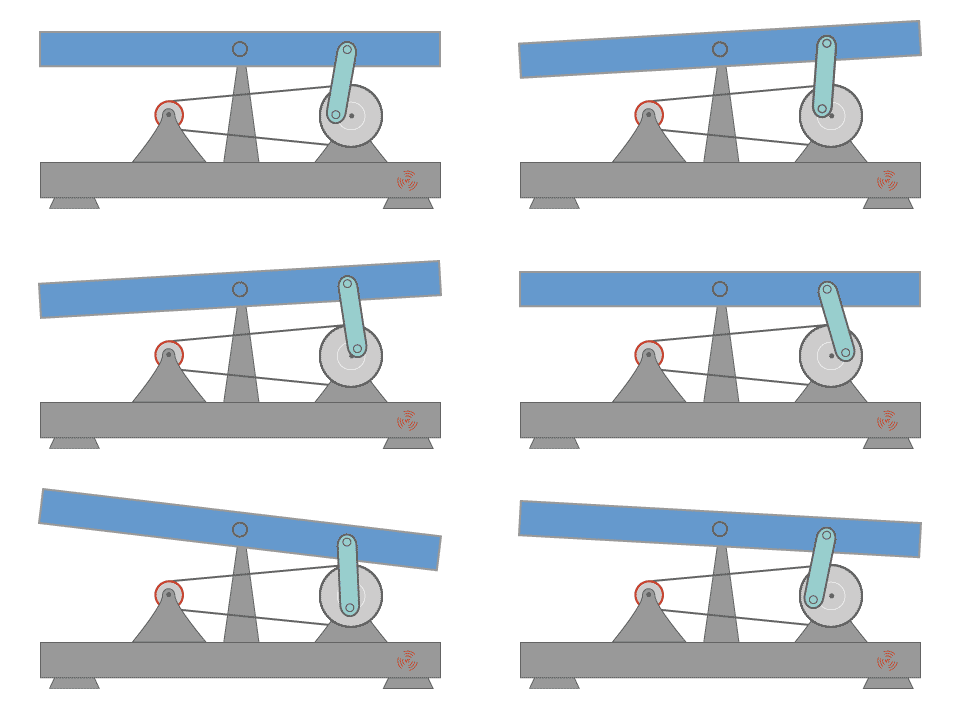 Low Frequency
High Amplitude |
Vibration Frequency & Amplitude
Vibration frequency and amplitude are two key parameters that determine the motion characteristics of a vibration plate. Together, they influence vibration acceleration (G-force), the resulting mechanical stimulation, and the musculoskeletal responses.
There is currently no scientifically established optimal combination of vibration frequency and amplitude for promoting bone growth. Numerous studies investigating vibration therapy for osteoporosis have examined frequencies around 30 Hz. The treatment efficacy also depends on exercise posture, treatment duration, and individual physiological conditions.
Resonance Frequency
Skeletal muscles exhibit variable natural frequencies because their mechanical stiffness changes with muscle activation. As muscles contract, their stiffness generally increases, raising their natural frequencies and altering their responses to vibration. Research has reported natural frequencies ranging approximately from 10 to 50 Hz in certain lower-limb muscle and soft-tissue groups, depending on muscle activation and mechanical conditions.
Frequencies between 25 and 40 Hz may overlap with the natural frequencies of activated major skeletal muscles, including the quadriceps, hamstrings, glutes, and calves. During vibration exercises, these muscles generate mechanical forces that are transmitted to weight-bearing bones. Their resonance characteristics may influence vibration transmission and the resulting mechanical loading, although the optimal frequency for promoting bone growth has not yet been established.
Vibration Training Poses
The following training poses promote vertical mechanical loading of weight-bearing bones while engaging different muscle groups.
| Training Pose | Targeted Muscles & Bones |
|---|---|
| Squat | Quadriceps, glutes and calves; femur, tibia and pelvis. |
| L-Squat | Quadriceps, glutes, hamstrings and core; femur, tibia, pelvis and lumbar spine. |
| Deadlift | Glutes, hamstrings and spinal erectors; femur, pelvis and lumbar spine. |
Summary
Vibration therapy offers a distinctive form of mechanical stimulation through rapidly repeated muscle activation and dynamic acceleration. Together, muscle-generated and inertial forces can produce repeated pulses of mechanical loading on bones, providing a plausible pathway through which vibration therapy may influence bone remodeling.
The effectiveness of this mechanical stimulation depends on vibration frequency, amplitude, G-force, exercise posture, and individual physiological responses. While research suggests potential benefits for osteoporosis under certain treatment conditions, the optimal combination of these parameters for promoting bone growth remains to be established.
References
- Is Vibration Training Good for Your Bones?
- By Jorge Marin-Puyalto, Alba Gomez-Cabello, Alejandro Gonzalez-Agüero, Alejandro Gomez-Bruton, Angel Matute-Llorente, Jose A Casajús, German Vicente-Rodríguez PubMed.gov | PMID: 30519579
- Vibration Therapy to Prevent Bone Loss and Falls: Mechanisms and Efficacy
- By Belinda R Beck PubMed.gov | PMID: 26456496
- Effect of 6-month whole body vibration training on hip density, muscle strength, and postural control in postmenopausal women: a randomized controlled pilot study
- By Sabine M P Verschueren, Machteld Roelants, Christophe Delecluse, Stephan Swinnen, Dirk Vanderschueren, Steven Boonen PubMed.gov | PMID 15040822