Designer's Insights on Vibration Plates
Content Index
- Presumption & Science
- Designs of Vibration Plate
- China Quality Insight
- In-House vs Outsourcing
- Insider's Perspective on Defect Rates
- Our Quality Strategy
- An Ongoing Endeavor
Presumption & Science
The use of mechanical vibration for health improvement has been around for more than a century, long before the development of modern vibration plates.
Early inventors promoted their vibration devices based largely on presumed health benefits or pseudoscientific explanations. Today, some manufacturers and sellers still employ a similar approach to marketing vibration plates.
Regardless of how vibration devices are marketed, they provide a unique form of mechanical stimulation to the human body, producing physical and physiological responses that may be utilized for health and medical purposes. This is the science behind vibration therapy.
In recent years, as the prices of vibration plates have been substantially driven down by Chinese manufacturers, millions of people are encouraged to explore the potential benefits of using these devices.
A wealth of user-reported positive outcomes strongly suggests that vibration therapy holds meaningful promise for a wide range of health benefits. Researchers are increasingly interested in establishing scientific evidence for the potential health benefits and developing effective therapeutic applications.
However, designing and conducting clinical trials that adequately evaluate the efficacy of vibration therapy presents considerable practical challenges. There is still no scientifically validated treatment protocol for most presumed health benefits of vibration therapy.
The effectiveness of vibration plate intervention depends largely on its motion direction, frequency and amplitude, as well as the user's health objectives, physical condition and exercise methods. These factors are central to both the study of treatment modalities and the engineering considerations behind vibration plate design.
Designs of Vibration Plates
In the absence of scientifically validated treatment protocols, vibration plates are generally designed to deliver moderate stimulation: neither too intense to pose undue safety risks nor too weak to produce meaningful physical and physiological responses.
There are various mechanical methods for generating vibration or similar reciprocating motion. The planar four-bar mechanism and the eccentric-wheel mechanism are predominantly used in vibration plate designs, producing two distinct motion patterns: pivotal oscillation and linear vibration, respectively.
| Actuator | Movement Pattern | Typical Parameters |
| Planar Four-Bar | Pivotal Oscilation | Low Frequency (5-16Hz) High Amplitude (8-10mm) |
| Eccentric Wheel | Linnear Vibration | High Frequency (15-40Hz) Low Amplitude (0.5-3mm) |
China Quality Insight
While China is home to many top-tier manufacturers producing world-class products, a large proportion of consumer products are made by countless small OEM factories that often lack engineering and quality standards in product design, validation, material selection and testing. Their product quality relies heavily on workmanship.
Small, off-brand factories tend to prioritize short-term business viability and fast turnaround, with limited investment in production automation. They typically pursue a business strategy centered on low production costs and competitive pricing. Such a practice contributes to the stereotype of Chinese product: low price, fair quality.
Vibration plates available on the market are mostly manufactured by these small Chinese OEMs and sold under a number private-label brands created by many emerging e-commerce sellers.
These small factories often take shortcuts in product development or simply copy designs from one another to respond quickly to market demand. New products can be readily put together using outsourced parts and processes and brought to market without adequate validation and testing. This practice often results in numerous similar product designs with short product life cycles. Many e-commerce sellers adopt a similar business strategy, prioritizing short-term viability and fast turnaround. Easy entry, quick exit.
In-house vs Outsourcing
In China, the barriers to entering the manufacturing business are relatively low, thanks to its extensive industrial infrastructure. Parts and manufacturing processes can be readily outsourced to numerous specialized suppliers and workshops nearby.
Small manufacturers rely heavily on outsourcing to keep overhead low and maintain operational flexibility. However, this reliance often exposes them to supply instability, production uncertainties and inconsistent product quality.
Medium and large manufacturers tend to be more vertically integrated, producing key components and assemblies in-house for better control over production and quality. They are generally more committed to the long-term development of their core products and more willing to invest in production automation to reduce reliance on manual labor and workmanship.
In-house manufacturing is not necessarily superior to outsourcing. The choice depends on the specialized manufacturing capabilities required for a particular component or process.
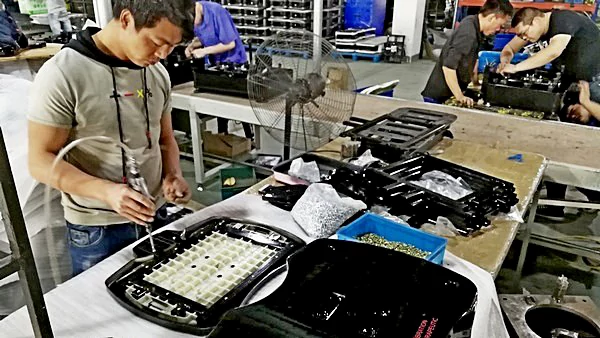
a worker assembles a VT003F
Our discontinued model VT003F is a good example. One of its major quality issues was related to the controller, which was assembled in-house at Jintuo using purchased circuit boards, connectors and switches. After assembly, the controller underwent functional testing with the machine.
However, Jintuo lacks the specialized testing equipment needed to thoroughly evaluate the quality and reliability of electronic circuits and components.
Loose wiring connections, cold solder joints or low-grade electronic components can shorten the service life of a controller or cause premature failure under electrical load surges. Such potential defects are difficult to detect through routine functional testing, posing a significant quality control challenge for in-house controller assembly at Jintuo.
The VT007 controller is designed as a detachable plug-in module, allowing us to outsource its entire production to a specialized PCBA manufacturer with the necessary facilities, manufacturing expertise and testing equipment to ensure the quality and reliability of electronic devices.
By outsourcing the entire VT007 control module to a qualified specialist manufacturer, we have achieved substantial improvements in product quality, consistency and reliability.
Insider's Perspective on Defect Rates
Small, off-brand OEM factories often lack consistently enforced quality standards. Besides their systemic drawbacks, defect rates are also influenced by factory owners' business mentality, customer relationships and prevailing trade conditions. Depending on these factors, factories may tolerate a "fair" defect rate to keep production costs low.
Most e-commerce sellers are price-driven in their supplier selection, while Chinese OEM factories strive to keep their prices competitive to secure purchase orders. When prices are driven too low, factories may resort to cutting corners in production and quality control processes or sourcing cheaper materials and components from random suppliers.
Some short-sighted factories tend to test the limits of acceptable quality. They may relax quality control or even substitute cheaper materials and components in subsequent production batches, hoping that these changes will not significantly compromise product quality. Common substitutions include thinner steel, recycled plastics and lower-grade electronic components, which may reduce production costs without noticeably altering the product's appearance.
Many e-commerce sellers lack loyalty to their OEM suppliers and readily switch factories in pursuit of lower prices. OEM factory owners, in turn, have little incentive to invest in product quality and long-term improvements for brands they do not own. They are more interested in securing orders through low prices and maintaining high production volumes.
Ultimately, e-commerce sellers and their OEM factories arrive at a commercial compromise between price and quality: low price, fair quality and tolerance of a certain defect rate. Products resulting from such business practices have achieved considerable commercial success on major e-commerce platforms such as Amazon.com, where many shoppers are highly price-sensitive.
Our Quality Strategy
Qualified OEM Partner
A qualified and committed OEM manufacturing partner is fundamental to our quality strategy.

Our long-term manufacturing partner, Zhejiang Jintuo, maintains an ISO 9001-certified quality management system and has extensive experience and strong engineering capabilities in the design and manufacture of fitness equipment.
Equally important are Jintuo's openness to our engineering input and its commitment to working with us to resolve technical and quality issues. Over the years, we have established a mutually beneficial working relationship with Jintuo, allowing us to leverage their manufacturing resources and expertise while maintaining control over our product designs and quality standards.
Close Collaboration and Active Involvement
Rather than simply placing purchase orders and relying on our OEM partner to deliver quality products, we work closely with Jintuo and actively participate in every stage of product development and manufacturing. From product design, material selection and component sourcing to manufacturing processes, assembly and quality control, we apply our own engineering knowledge, experience and quality standards throughout the manufacturing operation.
We also bring customer feedback directly to the factory floor, working with the engineering and production teams to identify the root causes of quality issues and implement corrective measures and design improvements. We believe that product quality cannot simply be specified in a purchase order or ensured through final inspection. It must be engineered into the product and built into the manufacturing process.
Upstream Supplier Quality Control
Outsourced parts and processes deserve particular attention because they often fall outside the OEM manufacturer's direct quality control and may be overlooked.
The quality of a finished product depends largely on the quality and consistency of its individual components. Even with strong manufacturing capabilities and rigorous internal quality control, an OEM manufacturer cannot consistently deliver high-quality products without effective quality management extending upstream to its component suppliers.
We have learned valuable lessons from overlooking quality control at our PCBA supplier, which contributed to higher defect rates in our legacy model VT003F and early versions of the VT007.
For vibration plates, the quality and consistency of electric motors, bearings, rubber springs, electronic components and molded plastic parts directly affect the machine's performance, reliability and service life. We work closely with Jintuo to select and qualify component suppliers, establish technical specifications and monitor component quality and consistency. We pay particular attention to unauthorized material substitutions, changes in manufacturing processes and cost-cutting practices that may compromise component quality. The consequences of such practices are often difficult to detect during finished product inspection and may only become apparent after extended use. Effective quality control must therefore extend well beyond the OEM factory's own production floor.
Bill of Materials
A well-defined and strictly controlled Bill of Materials (BOM) is essential for maintaining product quality and consistency across production batches. Together with its associated engineering documents, a comprehensive BOM defines components, material grades, technical requirements, approved suppliers and applicable quality standards. Without strict BOM control, suppliers may make substitutions for reasons of cost or availability without fully understanding the engineering implications.
We work closely with Jintuo to establish and maintain our product BOMs, with any proposed changes subject to engineering evaluation and approval. Effective BOM control not only ensures product consistency but also provides a technical foundation for quality traceability, product improvement and long-term replacement parts support.
Design for Manufacturing Consistency
Product quality and consistency can be substantially improved by designing products and manufacturing processes to facilitate automation and minimize reliance on individual workmanship.
Rather than relying heavily on the skills, experience and attentiveness of production workers, we design components and assembly processes to minimize the possibility of human error and manufacturing variation. This involves simplifying product structures, optimizing component geometry and dimensional tolerances, standardizing assembly procedures, and incorporating dedicated tooling, fixtures and automation wherever practical.
These design principles have been extensively applied to our VT007 and VT009 vibration plates, not only improving production efficiency but, more importantly, making product quality more predictable and less susceptible to workforce turnover.
An Ongoing Endeavor
Much remains to be explored in the science and applications of vibration therapy, and there is always room for improvement in vibration plate design and manufacturing. We will continue to advance our understanding of vibration therapy, learn from our users and apply our knowledge and experience to developing better vibration plates.
We believe that building a brand is a long-term engineering and business endeavor. It takes patience, persistent effort and a genuine commitment to product quality.
Vibration Therapeutic® LLC