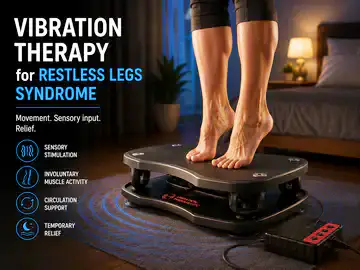
Recent Scientific Studies on
Vibration Therapy for Restless Legs Syndrome
Restless legs syndrome (RLS), also called Willis-Ekbom disease, is a sensorimotor disorder characterized by an urge to move the legs, usually accompanied by uncomfortable sensations. Symptoms typically emerge or worsen during rest, are more prominent in the evening or at night, and are temporarily relieved by movement.
Clinical evidence for vibration therapy in RLS is still limited, but it is increasingly meaningful. A small sham-controlled whole-body vibration study reported a significant reduction in RLS symptoms. More recent research has also reported improvement with local vibration. A 2025 systematic review and meta-analysis found a statistically significant reduction in RLS severity for vibration/stimulation interventions.
These findings support vibration as a promising non-drug intervention, but they do not establish vibration therapy as a proven treatment for all people with RLS. Larger, well-controlled trials are still needed.
Index
- What Causes Restless Legs Syndrome?
- Whole-Body Vibration — Direct Clinical Evidence
- Earlier Research on Vibration and Blood Flow
- Local Vibration Research
- Vibration Pads and Counterstimulation
- Exercise and Restless Legs Syndrome
- Skeletal Muscle Pump, Venous Return and Peripheral Circulation
- Tissue Fluid Movement and Metabolic Waste
- Muscle-Spindle, Reflex and Sensory Mechanisms
- What the Overall Evidence Tells Us
- Research Questions That Remain Open
- Conclusion
- Selected Research Sources
What Causes Restless Legs Syndrome?
The exact biological cause of RLS is not fully understood. Current medical research places substantial emphasis on brain iron regulation and dopaminergic pathways, and RLS can also occur in association with conditions such as iron deficiency, pregnancy, kidney disease, and certain medications.
At the same time, the characteristic temporary relief produced by movement suggests that peripheral physiological activity in the legs may also matter. Exercise, compression, sensory stimulation, circulation-related interventions, and several forms of neuromodulation have therefore been investigated as non-pharmacological approaches.
Possible peripheral contributors include altered blood flow, local tissue oxygenation, venous circulation, sensory signaling, muscle activity, and tissue-fluid movement. These are plausible research directions rather than established causes of RLS. Importantly, venous circulation is not supported only by physiological speculation: multiple clinical studies have reported an association between RLS symptoms and venous disorders. That association does not establish causation. Impaired lymphatic drainage or accumulation of metabolic waste, by contrast, has not been shown to have a comparable clinical association with RLS.
Whole-Body Vibration — Direct Clinical Evidence
A particularly relevant study was published by Mitchell, Hilton, Hunsaker and Ulfberg in the Journal of Clinical Sleep Medicine in 2016. Eleven people with RLS underwent both a two-week whole-body vibration intervention and a sham intervention in randomized order.
Participants stood with their knees flexed on a vibration platform and completed ten 30-second vibration bouts at 26 Hz and 2 mm amplitude, separated by one-minute standing rest periods. The entire intermittent session lasted approximately 14 minutes.
After two weeks, whole-body vibration significantly reduced RLS symptoms compared with baseline and with sham treatment. The authors concluded that the intervention decreased RLS symptoms in this small study.
The study is important for another reason: the researchers directly investigated blood flow as a possible mechanism. Although participants with RLS showed an abnormal baseline skin-blood-flow pattern and vibration acutely changed blood flow, two weeks of treatment did not produce a sustained increase in resting skin blood flow. The symptom improvement therefore could not simply be attributed to a lasting increase in resting skin blood flow.
This distinction is important. The study supports a therapeutic effect from whole-body vibration, but it does not prove why the effect occurred.
Earlier Research on Vibration and Blood Flow
Mitchell and Johnson previously investigated the immediate effect of whole-body vibration on skin blood flow in people with RLS. Their 2014 study was based on the hypothesis that vascular disturbance and tissue hypoxia might contribute to RLS symptoms.
The study demonstrated that whole-body vibration can substantially alter peripheral skin blood flow. However, blood-flow findings across these small studies do not establish impaired circulation as the underlying cause of RLS.
For vibration therapy, this leaves an interesting distinction: circulation may be one physiological response to vibration without necessarily being the sole mechanism responsible for symptom relief.
Local Vibration Research
Local vibration has also been studied. A randomized controlled trial published in 2026 compared local vibration with gabapentin in 36 participants. RLS severity and sleep-quality scores improved significantly after treatment in both groups, with no significant between-group difference at the measured timepoints. Some loss of benefit was observed at one-month follow-up, although scores remained below pretreatment levels.
This trial studied local vibration rather than a whole-body vibration plate, so its results should not be directly transferred to a particular vibration-plate protocol. Nevertheless, it adds evidence that mechanical vibration itself may have clinically relevant effects on RLS symptoms.
Vibration Pads and Counterstimulation
Vibration pads represent another form of vibration intervention. Unlike a vibration plate, a pad generally provides local sensory stimulation while the user is resting. This is commonly discussed as counterstimulation: an external sensory signal may compete with or modify the unpleasant sensations associated with RLS.
Earlier systematic reviews found that vibration pads did not consistently reduce RLS severity, although some sleep-related outcomes improved. These findings should not be treated as evidence either for or against whole-body vibration because the mechanical intervention, body response, and exercise component are substantially different.
Exercise and RLS
Movement is one of the defining features of RLS: symptoms are typically relieved, at least temporarily, by moving the affected limbs. Exercise has also shown benefit in some clinical studies and reviews, although the evidence varies by study population and protocol.
This is relevant to vibration plates because whole-body vibration is not merely passive sensory vibration. When a person stands or exercises on a platform, vibration repeatedly changes the mechanical load on the body and can induce repeated neuromuscular responses and skeletal muscle contractions.
Vibration exercise may therefore combine several interventions that are separately relevant to RLS: physical movement, muscular activity, sensory stimulation, mechanical stimulation, and acute circulatory effects. Whether this combination makes vibration exercise more effective than conventional exercise for RLS has not been established by comparative clinical trials.
Skeletal Muscle Pump, Venous Return and Peripheral Circulation
Repeated skeletal muscle contraction assists venous return through the skeletal muscle pump. Vibration intervention can induce rapidly repeated muscular responses, potentially adding repeated pumping action within the lower extremities. Active calf raises, tip-toe positions and squats further recruit the leg muscles that participate in this pumping function.
The possible relationship between venous circulation and RLS is supported by more than physiological reasoning. A 2025 systematic review of RLS and chronic venous insufficiency identified studies reporting positive associations with superficial venous reflux, varicose veins and chronic venous insufficiency. Several observational studies have also reported improvement of RLS symptoms following treatment of venous reflux.
These findings are intriguing but do not establish that venous return inefficiency causes RLS. Many of the studies involve selected vein-clinic populations, study designs and definitions vary, and venous treatment studies cannot by themselves determine the mechanism of symptom improvement.
The 2016 whole-body vibration trial also found symptom improvement without demonstrating a sustained increase in resting skin blood flow. Skin blood flow, however, is not the same physiological measurement as venous return. The study therefore argues against a simple explanation based on a lasting increase in resting skin perfusion, but it does not directly test whether skeletal-muscle-pump activity or venous hemodynamics contribute to the acute response.
Accordingly, venous return should be considered an evidence-supported research direction and a possible contributing mechanism, not an established general cause of RLS or a proven explanation for vibration-related symptom relief.
Tissue Fluid Movement and Metabolic Waste
Skeletal muscle contraction also assists movement of interstitial fluid and lymph. It is physiologically reasonable that repeated muscular activity can affect local tissue-fluid exchange and removal of metabolic byproducts.
Whether impaired lymphatic drainage, tissue-fluid stagnation, or accumulation of metabolic waste contributes to RLS has not been established. Clinical vibration trials have not directly tested these mechanisms. They remain hypotheses that may justify future research, not demonstrated explanations for RLS or for the effect of vibration therapy.
Muscle-Spindle, Reflex and Sensory Mechanisms
RLS is fundamentally a sensorimotor condition. Vibration provides intense, rapidly repeated mechanical sensory input while simultaneously producing neuromuscular responses. Muscle spindles are particularly responsive to vibration and contribute proprioceptive afferent signals to the nervous system. Vibration can therefore engage sensory and motor pathways at the same time.
The involuntary component of this muscle activity is a distinctive feature of vibration. In ordinary voluntary exercise, muscular contraction is initiated primarily through intentional motor commands. During vibration exercise, an external mechanical stimulus can additionally evoke reflex neuromuscular activity. The user can therefore combine voluntary movements such as a calf raise or squat with vibration-induced involuntary muscular responses.
Vibration-induced muscle activity is often discussed in relation to the tonic vibration reflex and stretch reflex because vibration strongly stimulates muscle-spindle afferents. Whole-body vibration physiology is more complex than a simple textbook stretch reflex, however. Experimental studies have found different reflex latencies and pathways depending on how and where vibration is applied and on vibration amplitude. It is therefore more accurate to say that whole-body vibration engages muscle-spindle, proprioceptive and reflex pathways than to assume that every vibration-induced contraction is a classic stretch reflex.
This distinction may be particularly relevant to RLS. The same intervention can provide strong somatosensory and proprioceptive input, induce involuntary neuromuscular activity, and permit voluntary exercise. Local vibration may operate partly through sensory counterstimulation, while whole-body vibration adds weight-bearing neuromuscular activity and exercise to that sensory input.
The relative contribution of sensory modulation, reflex neuromuscular activity, voluntary exercise, circulation and other mechanisms remains unresolved.
What the Overall Evidence Tells Us
A 2025 systematic review and meta-analysis of randomized trials of non-pharmacological interventions reported a statistically significant reduction in RLS severity for vibration/stimulation interventions. Earlier systematic reviews were more cautious and emphasized the small number and variable quality of studies.
The evidence has therefore moved beyond anecdotal observation, but it is not yet strong enough to define an optimal vibration frequency, amplitude, treatment duration, body position, or patient group.
Research Questions That Remain Open
- How effective is whole-body vibration compared with conventional exercise?
- Which vibration frequencies and amplitudes are most effective?
- Is treatment immediately before bedtime more effective than daytime use?
- How long does symptom relief persist after a session?
- Do people with particular RLS characteristics respond better than others?
- What roles are played by sensory modulation, muscle-spindle input, vibration-induced reflex activity, voluntary muscle contraction, peripheral circulation and venous return?
- Do active calf raises, tip-toe positions or squats during vibration produce a different response from passive standing?
- Does repeated vibration influence tissue oxygenation or local metabolic conditions?
- Can a practical home vibration protocol produce sustained improvement?
Summary
Vibration therapy for restless legs syndrome has a plausible physiological rationale and a growing, but still limited, clinical evidence base. A small sham-controlled study demonstrated significant symptom improvement after whole-body vibration, local-vibration research has produced additional positive findings, and recent pooled research supports further investigation of vibration and related stimulation therapies.
What remains unknown may be as important as what is known. Existing studies do not establish a single mechanism. Peripheral circulation, venous return, neuromuscular activation, sensory counterstimulation, exercise effects, and other physiological responses may contribute in different proportions.
For this reason, vibration therapy for RLS should currently be viewed as a promising non-drug intervention deserving further clinical investigation rather than an established replacement for medical diagnosis or treatment.
Selected Research Sources
- Mitchell UH, Hilton SC, Hunsaker E, Ulfberg J. Decreased Symptoms without Augmented Skin Blood Flow in Subjects with RLS/WED after Vibration Treatment. J Clin Sleep Med. 2016.
- Mitchell UH, Johnson PK. Vibration and skin blood flow changes in subjects with restless legs syndrome. 2014.
- Raissi G, et al. Effects of local vibration therapy and gabapentin on restless legs syndrome symptoms: a randomized controlled trial. 2026.
- Gupta B, et al. Effect of Vibration, Electrical Stimulation and Other Non-Pharmacological Interventions on Restless Leg Syndrome Severity and Sleep Quality: A Systematic Review and Meta-Analysis. 2025.
- Non-pharmacological interventions for restless legs syndrome: a systematic review of randomised controlled trials. 2018.
- Current Evidence on Nonpharmacologic Therapy in the Management of RLS: A Scoping Review. 2020.
- Alyahya MA, et al. The association between restless legs syndrome and chronic venous insufficiency: a systematic review. 2025.
- Cakar HI, et al. Whole-body vibration-induced muscular reflex: Is it a stretch-induced reflex? 2015.
- Corum M, et al. The reflex mechanism underlying the neuromuscular effects of whole-body vibration: Is it the tonic vibration reflex? 2022.
Vibration Therapeutic provides general educational information and does not provide individualized medical advice. People with persistent or worsening RLS symptoms should discuss diagnosis and treatment with a qualified healthcare professional.